 Those of us who own tuneable synthesizers posses an amazing freedom. For not only may we quit Equal Temperament and explore Just Intonation, but also we may use any frequency as our Pitch Standard. We are no longer tied to “A”=440 Hz. as our base frequency. But why choose one base frequency rather than another? Is the choice of a tuning Standard arbitrary? This article represents my research for a Standard which is based upon resonances found in the natural world. The key to unlocking these natural resonances is the Law of the Octave.
This article was published in 1/1 – the Journal of the Just Intonation Network (San Francisco) in 1985.
Click on the link to see the article in your browser or right-click to save the file to your drive.
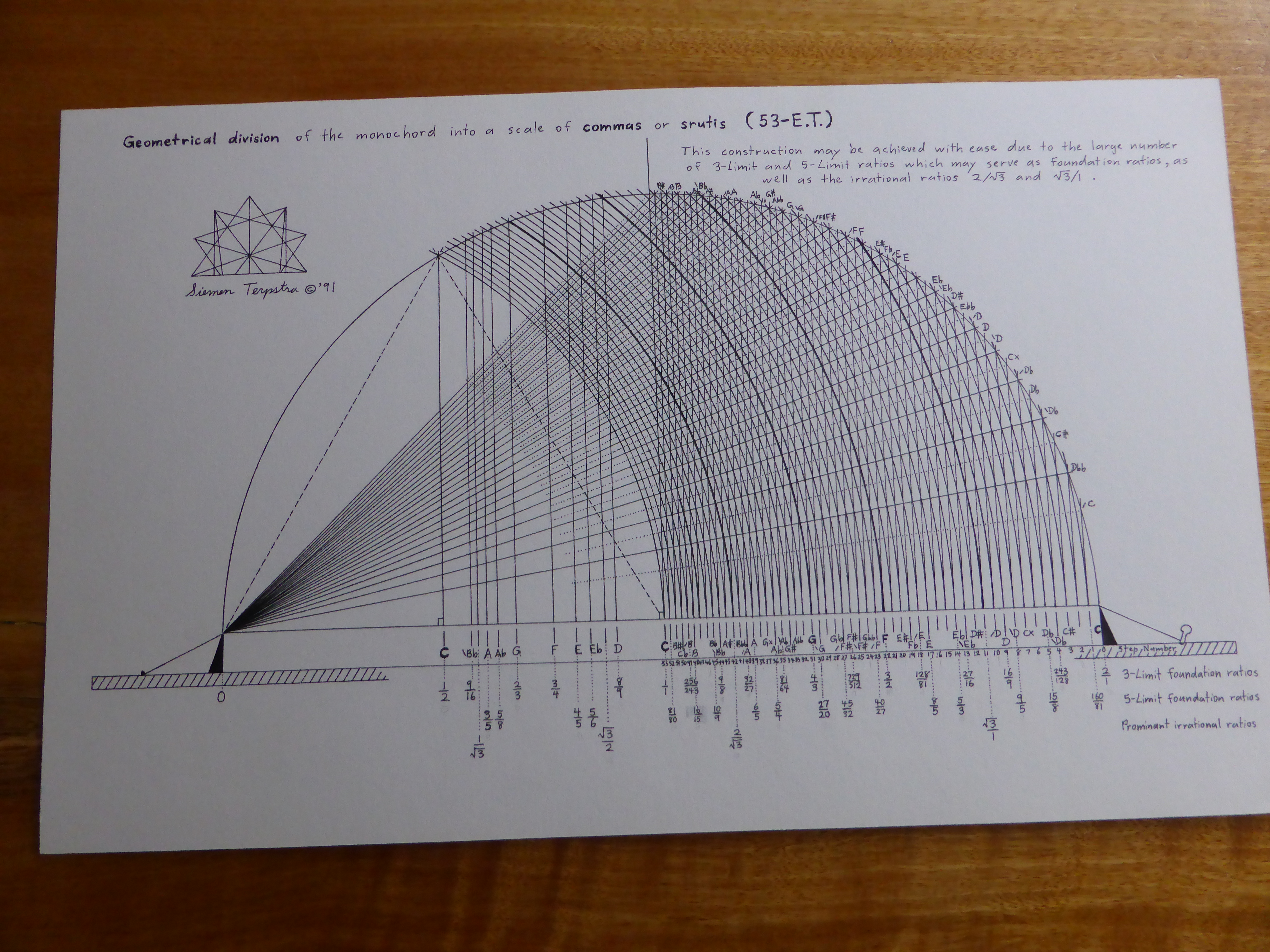
 An explanation of how the author derived a better notation for 53-E.T. from the practical experience of tuning stringed instruments in Just Intonation. The necessity of an organised efficient procedure in tuning by Harmonics led to the conception of a “field-map” which became the seed-bed for the new pitch notation and its functional counterpart.
 The two polychords are large steel guitars which were inspired by the ancient chinese instrument called the ch’in or ‘philosopher’s lute’. I wanted an instrument with a long scale length, yet short enough to be playable as a steel guitar (using a sliding bar or ‘steel’). Polychord 1 has two banks of strings; in other words, it is ‘double-necked’. Polychord 2 has a single bank of strings. These two instruments are meant to be together, and to compliment each other. Polychord 1 has a ‘chordal’ tuning; it is a ‘rhythm guitar’ in its orientation. Polychord 2 has a ‘scalar’ tuning; it is a ‘lead’ guitar. This is reflected in the tuning of each instrument.
 Each pattern defines a Class of Just scales, each Class embodying twelve primary modes (not presented here). Symmetrical structures are centred in the page; whereas, non-symmetrical patterns are paired by complementarity. Historical references are presented where appropriate. The classification progresses from generally “horizontal” tuning to generally “vertical” tunings.
 Back in the middle 1980’s I had an idea for converting a standard keyboard into a keyboard capable of applying 53-equal temperament. It was developed for the Apple 2E computer synthesizer called the Soundchaser. It uses software to change subsets of the wider field of possibilities. This file also includes a printout of the computer program. The project was funded by a Canada Counsel Arts Grant.
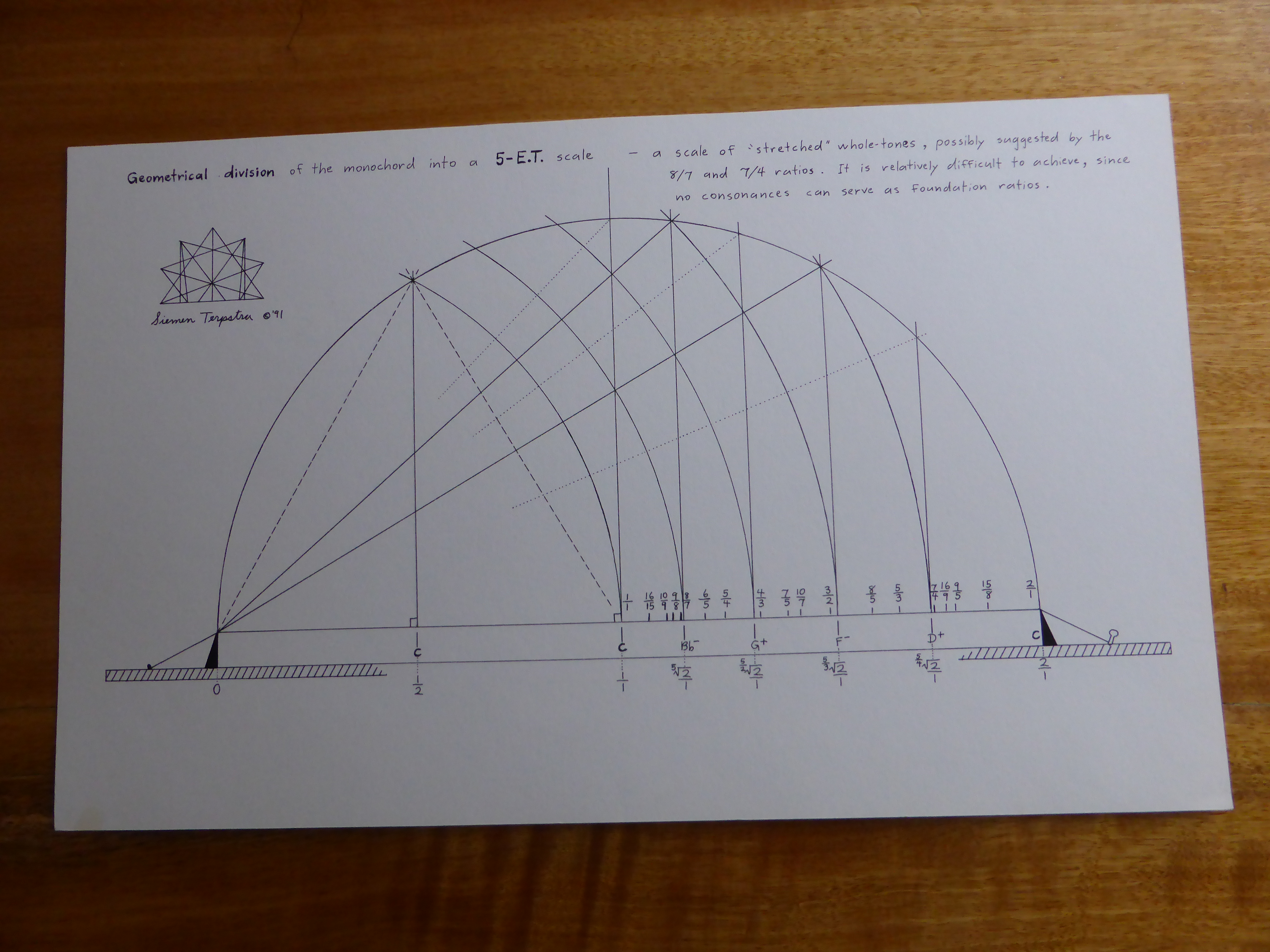
 The author explains how tendencies within the structure of the Pythagorean chromatic scale supported the transfer to Just Intonation; however, certain features of Just Intonation necessitated the application of some form of temperament. The meantone temperament formed the best compromise for the musical styles that were being explored. The author aims at a co-relation between tuning paradigm and associated musical style.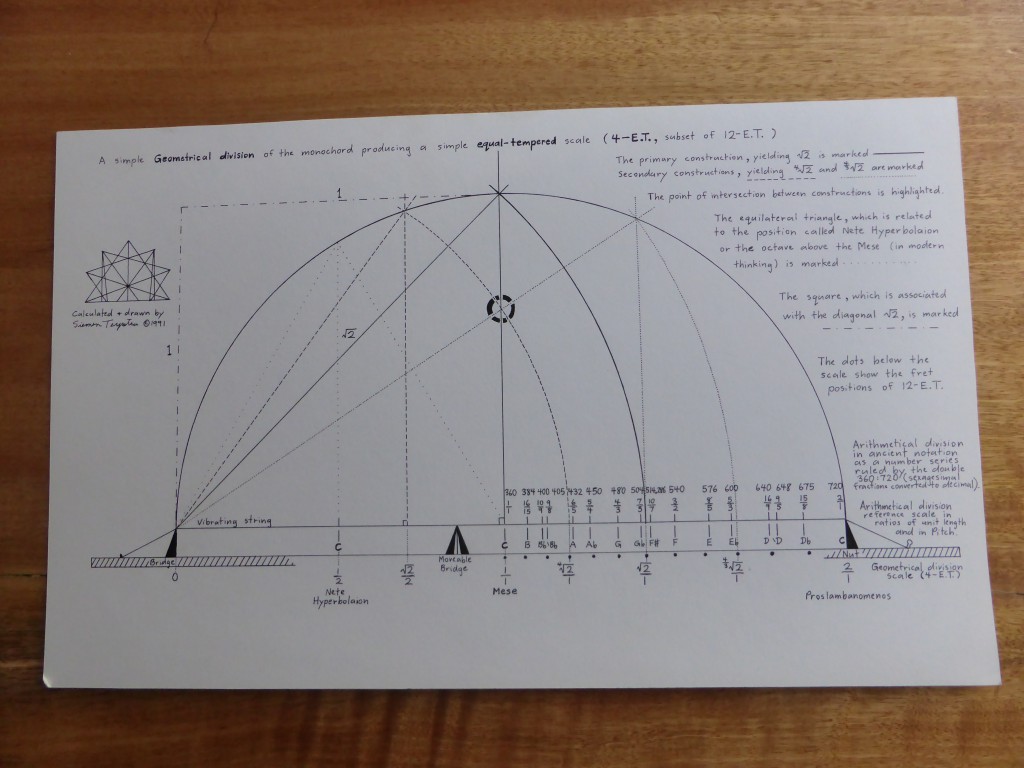

 The Spectrum Keyboard is a redesigned music keyboard intended for digital synthesizers, samplers, and other electronic media applications. It is planned as a ‘musical typewriter’, making the playing of chords and scales much easier than the old black-and-white keyboard. This is the first version (1988) of the keyboard built in New York in 1991 called the Terpstra-keyboard.
 The GLOBAL KEYBOARDS refer to a complimentary pair of generalized musical typewriters for computer-based electronic media. Since the design was formulated in 1986 it has been given several names: the Spectrum Keyboards (after a discarded color scheme), the One-Circle Global Keyboards (after an essential parameter of the design), or just my generalized keyboards. The complimentary relation between the two keyboards has also led me to call them male and female.
 The author responds to the article “Just Inton(ot)ation,” written by Paul Rapoport and published in 1/1, Volume 7, Number 1 (September 1991).